GSTR-1 is the return where a pharmacy's daily billing becomes a tax document. Most of the pain is not tax law — it is that the shop's records and the return were maintained in two different places, and somebody has to reconcile them before the deadline. Here is what actually goes wrong, and how to make the return a by-product of billing.
What GSTR-1 contains
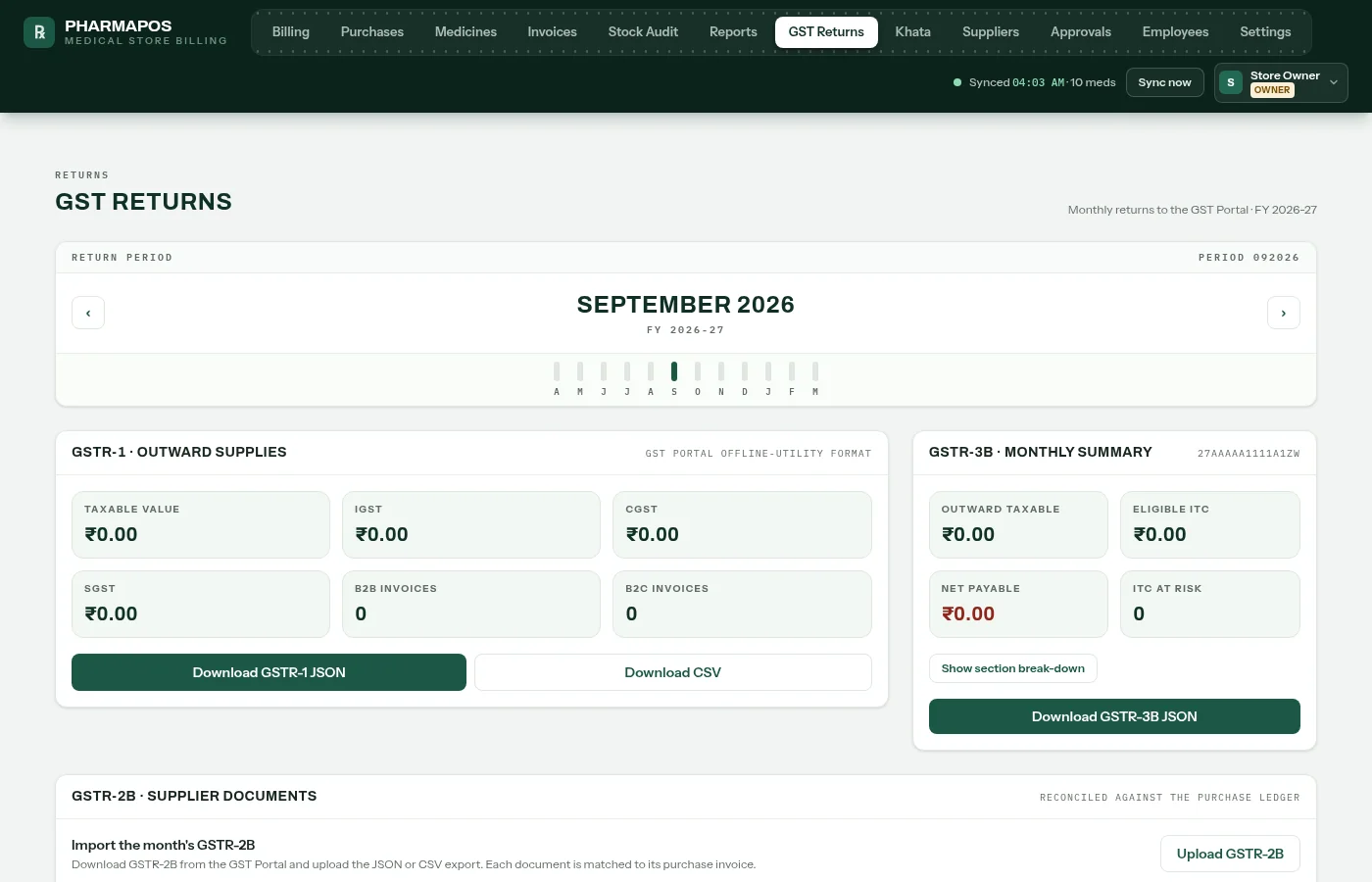
GSTR-1 reports your outward supplies — everything you sold — for a period. At its simplest it answers: to whom did you sell, what did you sell, how much tax did you charge, and which invoices were cancelled or returned. For a medical store the pieces that matter are:
- Invoice series and document numbers: every sale invoice with its number and date, continuing in sequence from bill to bill.
- B2B invoices: sales to other businesses with a GSTIN — the wholesaler next door, a clinic, a hospital, a company buying for its staff.
- B2C sales: the ordinary counter sales to walk-in customers.
- HSN summary: the goods sold, summarised by HSN code with quantity and taxable value.
- Credit notes: returns and adjustments, which reduce the period's outward supplies.
Mistake 1: returns that never make it into the return
A customer brings back a strip in the same month; the shop gives a credit note on paper. If the return is not recorded in the software, GSTR-1 still declares the original sale and the tax is paid on money that came back. Multiply that by a few dozen returns a month and it becomes real money. The rule we suggest to stores: if money went back to the customer, an entry goes into the software the same day.
Mistake 2: one HSN for everything
"Medicines" is not an HSN code. Medicines carry codes like 3004 with different tax rates, and other goods in a medical store — surgical dressings, cosmetics, devices, general items — sit in completely different chapters with different rates. When the HSN summary is wrong, the tax split is wrong too, and correcting it means rebuilding the period from invoices.
The practical fix is to set HSN and GST rate once, on the medicine entry, and never type them on a bill again. Engineers of PharmaPOS treat the rate as catalogue data, exactly for this reason: a rate typed at the counter is a rate typed wrong during a rush.
Mistake 3: rate changes and old bills
GST rates on medicines do change. When they do, the software has to apply the new rate to new bills while keeping old invoices exactly as issued. If a system "helpfully" recalculates history, your previous periods stop matching what you filed. Test this before you need it: ask the vendor what happens to last quarter's invoices after a rate change.
Mistake 4: reconstituting the return at month end
The most common reason a pharmacy dreads GSTR-1 is that the return is assembled from whatever is available at the end of the month — a day book, a printer's bill file, a half-filled register. If the billing software produces the GSTR-1 data directly, the month-end job changes from "recreate" to "review and upload", which is a different kind of evening.
Mistake 5: ignoring GSTR-2B until it is too late
GSTR-2B is the portal's statement of what your suppliers declared against your GSTIN. Every pharmacy has the same experience: a pile of purchase bills, some of which never appear in 2B because the distributor has not filed. Import 2B, reconcile it line by line against your purchase entries, and chase only the missing ones — instead of discovering at year end that input credit was silently lost.
A month-end routine that takes an hour, not a day
- Keep billing in one system, with HSN and rates set on the catalogue.
- Record every return as a credit note against its invoice, the same day.
- Enter every purchase with the supplier's invoice number and GSTIN.
- Two days before filing, import GSTR-2B and reconcile it with your purchases.
- Generate GSTR-1 and GSTR-3B from the software, review the summary with your accountant, then upload.
This is practical guidance from shipping billing software, not tax advice. Your accountant decides what your business files — the job of your software is to make sure the numbers they file come from your real counter, untouched.